

If you sell online, most of your capital decisions come down to timing. Cash goes out for inventory, ads, and suppliers weeks or months before revenue comes back in. A business loan closes that gap, and what you can use it for is broader than many ecommerce founders assume.
Answering the Question Fast: What Can You Use a Business Loan For?
A business loan can fund almost any legitimate operating or growth activity that moves your ecommerce brand forward. Business loans are a flexible financing option for ecommerce and digital founders, covering everything from restocking best-sellers to scaling paid acquisition campaigns. The key is matching each dollar of borrowed capital to a specific business purpose that generates enough margin to cover repayment.
Here are the most common uses for online brands:
- Buying inventory and placing reorders on proven SKUs
- Scaling marketing and ad spend on Meta, Google, TikTok, or influencer channels
- Bridging payout gaps from Amazon, Shopify Payments, PayPal, or card processors
- Building stock ahead of seasonal peaks like Black Friday, Prime Day, or Q4 gifting
- Paying supplier deposits and meeting minimum order quantities
- Funding tools, tech stack upgrades, and fulfilment infrastructure
- Smoothing cash flow so a profitable store does not stall on a timing mismatch
Funds can also refinance expensive short-term debt in some cases, though that requires careful analysis. What a business loan should not do is cover personal spending unrelated to the business or mask a model that is structurally unprofitable.
Uncapped provides non-dilutive funding to ecommerce brands through Term Loans and, in the US, a Line of Credit and Cash Advance, with no restrictions on how the money is spent. Business loans allow you to keep profits without sharing equity or ownership.
Using a Business Loan for Inventory and Reorders
Inventory is usually the single largest cash outlay for an ecommerce brand. Stockouts kill momentum, long lead times from overseas suppliers demand early commitments, and large purchase orders tie up cash for months before a single unit ships. Funding inventory purchases is a common use of business loans for maintaining stock levels that match demand.
A business loan for inventory typically covers:
- Placing larger purchase orders for peak periods: a Q4 container order placed in July, for instance, ties up capital for four or five months before the first sale
- Reordering proven SKUs where sales data from Shopify or Amazon shows consistent velocity
- Securing bulk or early-payment discounts from manufacturers who offer better unit pricing for upfront commitments
- Bridging the production-to-delivery cycle without draining the operating account needed for ads, payroll, and tools
The risk is straightforward: if forecasts are wrong, you end up holding dead stock. Best practice is to tie the loan term to your inventory turn rate. If a product sells through in 60 to 90 days, a repayment window that stretches far beyond that means you are paying for stock long after it has left the warehouse. Use historical SKU performance data to plan quantities, not optimism.
For a deeper look at how online brands structure inventory financing without giving up equity, our guide covers the mechanics in detail.
Marketing and Ad Spend: Fueling Growth With Business Loans
Paid customer acquisition is the second major cash sink for most ecommerce brands. Businesses often secure loans to support marketing and advertising campaigns where ad spend happens today and revenue arrives days or weeks later. That lag is a structural cash flow problem, not a sign of poor performance.
Founders typically use business loans for marketing to:
- Scale campaigns that already show a positive ROAS or strong MER: borrowing to amplify what works, not to gamble on what might
- Increase daily Meta or Google spend in the run-up to Black Friday or a product launch, when CPMs rise and budgets need to stretch further
- Fund influencer partnerships, affiliate commissions, or creative production for new ad formats like TikTok or YouTube Shorts
- Smooth the delay between ad spend and collected revenue, especially when payment processors hold funds on weekly cycles
The warning is simple: do not borrow at scale to test completely unproven channels. Test small with internal cash, prove the unit economics, then use borrowed capital to scale.
Repayment structure matters here. A cash advance repaid as a share of sales can suit performance marketing–driven brands where revenue is volatile week to week. Consider a DTC skincare brand using a business loan to push a product launch campaign across Meta and influencer channels, then repaying from the resulting sales over the following weeks. The mechanics of ad spend financing are worth understanding before committing capital.
Bridging Payout Gaps and Smoothing Cash Flow
Ecommerce sellers rely heavily on platforms that do not pay out instantly. Amazon, Shopify Payments, PayPal, Klarna, and card processors all release funds on weekly or longer cycles. Some hold reserves against chargebacks or returns. The result: a store can be profitable on paper and still unable to cover payroll or pay a 3PL invoice on time.
Working capital loans help businesses cover day-to-day operational costs during cash flow dips like these. Cash flow management is crucial for business survival and growth, and a timing mismatch is not the same as a money problem.
Business loans and lines of credit help here by:
- Covering the gap between making sales and actually receiving cash in your account
- Managing fixed operational costs (rent, payroll, software subscriptions, 3PL invoices) when platforms hold reserves or lengthen settlement times
- Preventing the “cash crunch” scenario where a profitable store cannot reorder inventory or cover payroll simply because cash has not landed yet
Business loans can stabilize cash flow during emergencies, whether that is a delayed platform payout or an unexpected supplier invoice. At a high level, a term loan gives you a lump sum with a predictable repayment schedule, while a revolving line of credit lets you draw and repay as gaps appear.
Our Cash Advance (US only), repaid as a fixed share of sales collected weekly or every 14 days, can align with variable ecommerce cash flow: repayments fall when sales slow and rise when sales pick up. For more on planning around payout cycles, see this guide to building a 13-week cash flow forecast.
Seasonal Peaks, Launches, and Expansion Campaigns
Seasonal demand is an opportunity, not just a risk. Companies typically secure loans to fund business expansion or acquisitions of market share during the windows that matter most. The challenge is that the investment is front-loaded and the return comes later.
Concrete scenarios where ecommerce brands deploy capital:
- Peak seasons: building stock for Black Friday/Cyber Monday, Singles' Day, Christmas, Mother's Day, back-to-school, or Prime Day: each requires inventory, creative, extra ad budget, and often additional fulfilment capacity weeks or months in advance
- Product launches: new product line drops, bundles, or limited editions requiring both production and marketing spend before the first unit ships
- Geographic expansion: launching into other countries (entering the EU from the US, or vice versa) adds localisation, logistics setup, regulatory compliance, and marketing costs that do not generate immediate revenue
Matching loan term to campaign timeline reduces risk. Funding that runs through the entire peak season and a few months beyond gives you room to sell through remaining inventory and collect receivables. Market conditions shift, so build a seasonal cash flow forecast that accounts for best-case, expected, and worst-case demand before committing to a funding amount.

Supplier Deposits, MOQs, and Better Terms
Many overseas and large-scale suppliers require 30 to 50 percent deposits on manufacturing runs, with strict minimum order quantities. Small business owners often face a choice: meet the MOQ and secure production capacity, or order conservatively and risk losing the slot to a larger buyer.
A business loan helps by:
- Covering upfront deposits so you lock in production capacity without emptying your operating account
- Paying faster or in full in exchange for price breaks, exclusivity, or priority in production: better payment terms translate directly to better unit economics
- Reducing dependence on supplier credit where terms are short or carry punitive late fees
The discipline: only borrow to meet MOQs on SKUs with strong demand signals. Speculative mega-orders on untested products are a fast path to dead stock. Founders should combine supplier terms, internal cash, and external financing rather than leaning on just one source. Our guide to purchase order financing for ecommerce covers how to structure these deals without killing cash flow.
Tools, Platforms, and Fulfilment Infrastructure
Tools and operations costs are smaller per line item than inventory, but they compound. When a better email/SMS platform lifts repeat purchase rate by 15 percent, or a new 3PL setup cuts shipping times and returns, the ROI justifies using a business loan.
Common funded investments include:
- Ecommerce tools: email and SMS suites, review platforms, subscription billing, analytics dashboards, creative automation, and A/B testing platforms
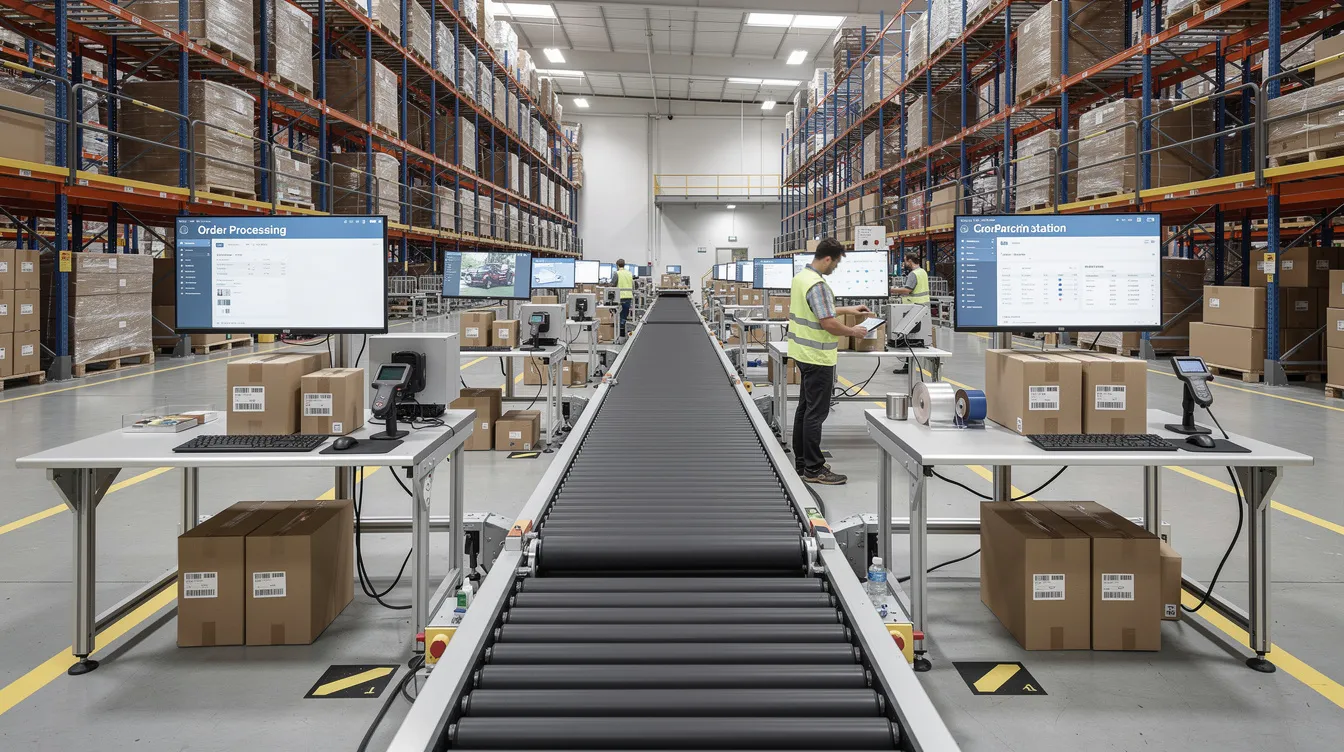
- Fulfilment infrastructure: 3PL setup fees, warehouse racking, packing stations, packaging equipment, label printers
- Operational upgrades: better inventory management, order management, or returns solutions that reduce errors and customer churn
One-time implementation costs (a new fulfilment centre setup or a platform migration) are more appropriate for a term loan with structured repayment. Ongoing subscription tools are generally better covered by recurring revenue, not a lump sum of debt.
Apply an ROI lens: fund tools where improved efficiency, higher average order value, or better retention is realistic and measurable. If you cannot sketch how the tool pays for itself within the repayment window, it probably should not be funded with borrowed capital.
Equipment Financing vs. General Business Loans
Equipment financing is a specific type of loan secured by the equipment being purchased, with the repayment term often matching the asset's useful life. Technology and machinery purchases often require substantial capital financing, and this structure keeps the cost tied directly to the asset generating value for business purposes.
For ecommerce brands, relevant equipment includes:
- Warehouse gear: forklifts, conveyor belts, packing stations, label printers
- Production equipment: printers, cutters, roasting or mixing machines for brands that manufacture or customise in-house
- IT hardware: servers, high-spec design machines, photography and video equipment for content creation
Companies use loans for purchasing equipment such as warehouse gear, production machinery, or IT hardware that is essential for operations, and business loans can fund equipment purchases whether through a specialised equipment financing product or a general business loan. An equipment purchase through dedicated financing tied to buying new equipment may carry a lower effective cost because the asset itself serves as collateral. A general business loan offers more flexibility: you can use funds for equipment and other business needs in the same facility.
For context, the U.S. Small Business Administration 7(a) loan program is a structured financing option for businesses, and SBA loans can reach up to $5 million for small businesses. SBA loan programs can be used for real estate or major equipment and generally offer lower interest rates and longer repayment periods. Loans can also fund the acquisition of commercial real estate or facilities, including a commercial space or commercial property for warehousing or production. Whether you are a franchise owner opening a new location or a DTC brand building in-house production, the right structure depends on the asset's useful life and your revenue profile.
Working Capital vs. Long-Term Investments: Matching Use to Repayment
The principle is simple: match the length of the loan to how long the benefit from the spend will last.
- Working capital uses (inventory cycles, ad campaigns, short-term cash flow gaps) generate returns within weeks or a few months. These suit short- or medium-term repayment. Term loans provide predictable payments for better expense management, and term loans can cover expansion and working capital needs on a fixed schedule.
- Longer-term investments (replatforming an ecommerce site, a major brand redesign, moving into new markets, building in-house production) take six to twelve months or longer to show returns. These need longer repayment windows.
Funding a long-term bet with an ultra-short repayment schedule puts pressure on cash flow before the investment pays back. The reverse, using long-term debt for a quick inventory flip, means you are paying interest well after the goods have sold. Term loans involve borrowing a lump sum with fixed payments, so the interest rate and total cost should factor into every decision. Rates vary based on the lender, your revenue profile, and prevailing benchmarks like the prime rate.
With a cash advance such as ours, repayments flex with sales, which can align well with growth investments whose payback curve is uncertain. For a detailed comparison, see term loan vs. revenue-based financing for ecommerce.
Refinancing Expensive Short-Term Debt (Use With Care)
Some ecommerce founders accumulate multiple funding facilities: a merchant cash advance here, high interest credit cards there, a daily-deduction product from a platform lender. When these stack up, the combined drag on cash flow can be worse than the original problem they solved. Debt refinancing allows businesses to consolidate high-interest loans for better rates and a clearer repayment structure.
When refinancing makes sense:
- Consolidating several daily-deduction facilities into a single repayment schedule at competitive rates, reducing cognitive and cash flow overhead
- Checking total repayment, fees, and loan terms rather than focusing only on lower apparent monthly payments: a longer term at a slightly lower rate can still cost more in total
- Pairing refinancing with an operational plan to improve margins, reduce returns, or optimise ad spend
Refinancing should not mask a fundamentally unprofitable product or business model. If unit economics are negative, a cheaper loan does not fix the problem; it delays it. We only refinance funding for our own existing customers, so for other providers' debt, talk to those lenders or an adviser.
What You Generally Should Not Use a Business Loan For
How you deploy borrowed capital matters as much as getting credit approval. Misusing funds increases risk even for growing ecommerce brands.
Uses that consistently lead to trouble:
- Personal expenses: non-business travel, lifestyle upgrades, or withdrawals unrelated to operations. These complicate accounting and often violate lender terms.
- Covering ongoing operating losses with no path to profitability. If return rates are unsustainably high or unit economics are negative, borrowing deepens the hole.
- Highly speculative bets disconnected from core product-market fit: untested category launches, crypto side-projects, or unrelated investments with no demand validation.
- Plugging structural issues (broken fulfilment processes, persistent product quality problems, or poor customer service) without fixing the root cause first.
Before taking on a loan, build a simple plan showing how borrowed capital will convert into revenue and margin. If you cannot trace a funded initiative back to a sale, the spend probably should not be funded with debt.
Business Loans vs Lines of Credit for Online Brands
Understanding the difference between credit products helps you pick the right structure for each need.
A traditional business loan delivers a fixed amount, a lump sum, with structured repayment over an agreed term. A business line of credit provides quick access to funds up to a predetermined approved amount, which you draw against and repay as needed, making it a revolving facility. Business lines of credit allow borrowing against a predetermined limit, and a business line of credit helps manage cash flow fluctuations. Business lines of credit help manage short-term expenses that recur unpredictably.
| Business Loan | Business Line of Credit | |
|---|---|---|
| Structure | Lump sum, fixed repayment | Revolving, draw as needed |
| Best for | Large inventory orders, seasonal campaigns, platform migrations | Ongoing cash flow gaps, small inventory top-ups, short marketing pushes |
| Repayment | Fixed schedule | Pay on drawn amount, then re-draw |
| Flexibility | Lower: committed to full amount | Higher: use only what you need |
Key factors beyond the interest rate alone: speed of easy access to funds, flexibility, impact on daily cash flow, and total cost of capital. Traditional banks may assign a relationship manager and offer secured lines against business assets, but the application process is typically slower. Invoice financing allows borrowing against outstanding invoices, which suits brands with large wholesale or B2B receivables more than pure DTC sellers. Invoice financing gives access to funds against outstanding invoices, another source of working capital.
Non-dilutive providers structure funding as term loans, cash advances or revolving credit, and a term loan can serve a similar role to a business line of credit for high-velocity online brands. Business loans help maintain cash flow during emergencies regardless of which structure you choose.
Uncapped's Funding Options for Ecommerce Brands
We offer non-dilutive funding for ecommerce brands, so founders can grow without giving up ownership or signing a personal guarantee.
Core offerings:
- Term Loans from $10K to $2M in the UK and US, with one fixed fee from 0.7% per month and terms up to 24 months. The full cost is known upfront, and no personal guarantee is required.
- Cash Advance (US only) from $10K to $100K, with one fixed fee agreed upfront and no interest. Repayment is a fixed share of sales (5% to 25%), collected weekly or every 14 days, so repayments follow actual business performance.
- Line of Credit (US only) from $25K to $2M, at a fixed APR from 12.99%. You only pay interest on what you use, and can repay early or redraw anytime with no prepayment fees.
Ecommerce founders typically use these for inventory and reorders, marketing and ad spend, seasonal build-ups, supplier deposits, and tools or fulfilment costs. Decisions use real sales and bank data, and applying doesn't affect your credit score.
For more on how ecommerce business loans work without a personal guarantee, or how to evaluate working capital options for multi-channel brands, our resource library covers each topic in depth.
Eligibility Requirements and Preparing to Apply
Every lender has its own eligibility requirements, and what qualifies you for one product may not qualify you for another. Criteria vary based on business model, revenue, trading history, and structure.
What lenders typically assess:
- Trading history: most require at least six months of operations
- Monthly revenue levels: thresholds range from $10K to $100K+ depending on the provider and whether you sell via marketplaces or DTC
- Business structure: incorporated entities (LLC, Ltd) with a business bank account separate from personal finances
- Credit history and financial statements: some lenders pull personal credit; others, like us, decide on real sales and bank data, and applying doesn't affect your credit score
- Financial health indicators: margins, return rates, sales trends
Uncapped-specific criteria:
- An ecommerce business, including Amazon and Walmart Marketplace sellers
- At least six months of trading history
- Monthly revenue of typically $100K+ for online brands, $10K+ for Amazon sellers or $5K+ for Walmart Marketplace sellers
- A business in the UK, US or Canada (US Amazon sole proprietors can apply for Term Loans of up to $30K)
- Connected sales platforms and business bank account, so decisions can use real sales and bank data
Preparing your credit application:
- Pull sales and performance data from Shopify, WooCommerce, Amazon, or marketplaces
- Prepare recent bank statements and basic financial statements
- Build a simple use-of-funds plan: show how inventory, marketing, or other spend will drive revenue and support repayment
- Review other restrictions or eligibility criteria on your chosen lender's site, since third-party summaries may not reflect current terms
Online applications speed up access to funding for qualified businesses. With us, you get a decision within 24 hours (many Amazon offers come in minutes), with no pitch deck or business plan needed. For a step-by-step walkthrough, see this ecommerce seller financing guide.

Deciding If a Business Loan Is Right for Your Ecommerce Brand
The question is not whether you can borrow. It is whether the spend will convert into margin fast enough to cover the repayment and still leave you better off.
Legitimate uses worth funding:
- Inventory and reorders on proven SKUs
- Scaling ad campaigns with demonstrated ROAS
- Bridging cash flow gaps caused by platform payout delays
- Seasonal stock builds and launch campaigns
- Supplier deposits that improve unit economics
- Tools and fulfilment upgrades with measurable ROI
- Carefully structured refinancing of expensive short-term debt
For each use, map it to an expected payback period and choose loan options or financing options that align with that timeline. A two-month inventory cycle does not need a 24-month term. A market expansion that takes a year to generate returns should not sit on a 90-day repayment.
Size the request to the plan, not to the maximum on offer; see how much you can borrow for how lenders size offers. Run basic projections on how funded initiatives will affect revenue, margin, and cash flow over the next six to twelve months. Consider non-dilutive options if you want to push your business forward without selling equity or giving a personal guarantee. Finding a trusted lender and financial partner who understands ecommerce, not just small businesses in general, makes the difference between additional funds that accelerate growth and debt that constrains it.
Small business loans, SBA loans, lines of credit, and revenue-based financing each serve different business needs. The best loan is the right loan for your specific situation, your margins, your repayment capacity, and your business's success trajectory. Making informed decisions here protects your financial health and keeps you in control.
Explore our Term Loans and Cash Advance to see whether they fit your next move, and check the dedicated resources on inventory financing and working capital for deeper guidance on specific use cases. Applying doesn't affect your credit score, and you get a decision within 24 hours.


